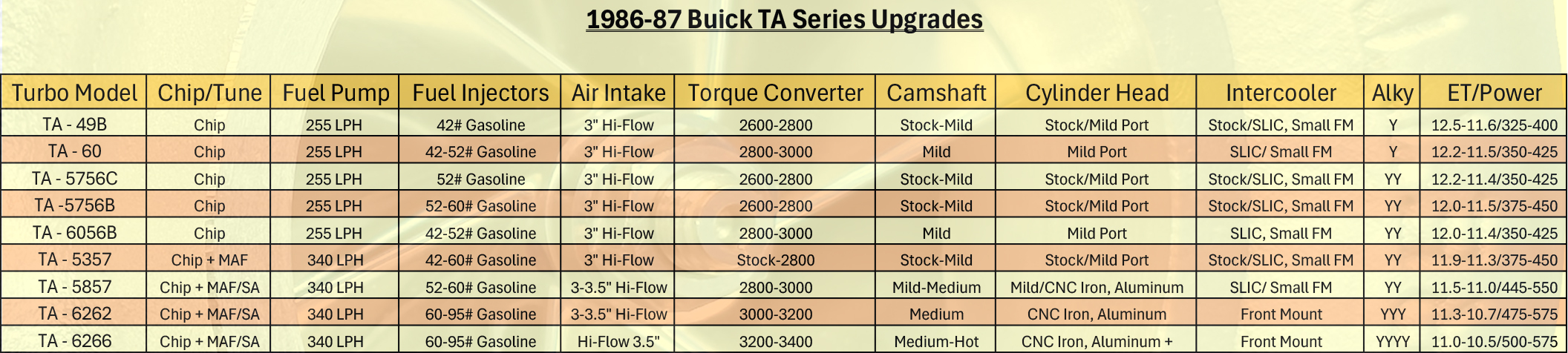
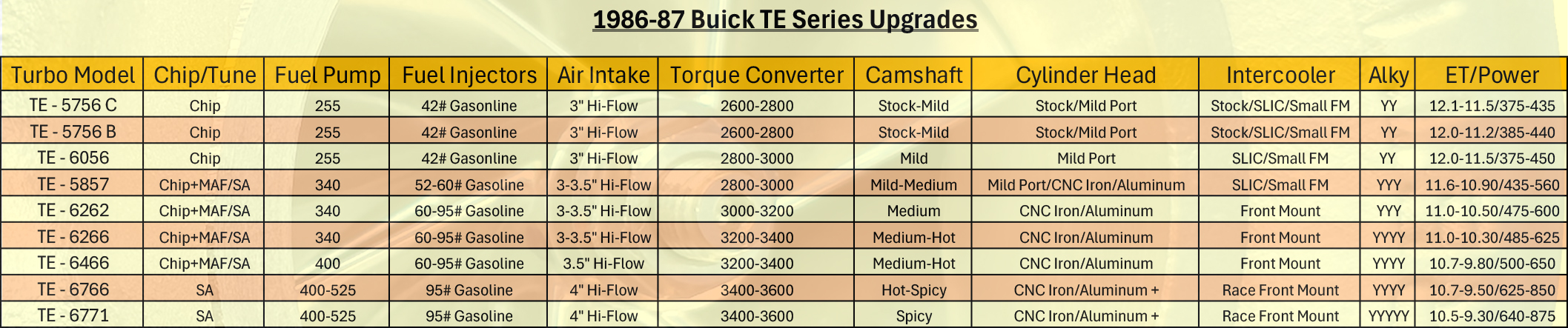
How to use and what you need to know about the Buick Turbo Matrix!
First off, there are 3 basic turbo sizes we offer. TA series turbochargers are your STOCK APPEARING units, meaning from the outside they are 100% stock housings that I machine to suit larger rotor groups. Super stealthy, but limited on power and efficiency. TE series turbos will still bolt right up to stock intercoolers and air intake pipes but offer higher flow capacity. We have been 9.40’s in 3700# car with this housing. The G4S housings are 4” inlet and Ported Shroud, opening up new technology compressor wheels for un-matched power and efficiency. These will not work with stock location intercoolers easily.
Next, follow this guide:
1. Find the turbo you are interested in on the left column
2. Look at the suggested modifications in the corresponding row
3. Match the turbo choice to the modifications you have planned for the best result
Chip/Tune:
· All turbos require at least an upgraded computer chip. We recommend using Eric Marshall at www.turbotweak.com
· MAF is the MASS AIRFLOW sensor size, use the suggested size for un-restricted inlet flow to your turbo.
· SA is short for STAND ALONE ECU (ECU-GN, Holley, FAST etc)
Fuel Pump:
· It is recommended to upgrade the fuel pump and wiring on even a stock Turbo Buick, the listed sizes are the minimum size needed to support the turbo you are considering. Always remember, fuel delivery is one of the single most important parts of your upgrade!
Fuel Injectors:
· These are the minimum fuel injector size you will need to support the modifications and power for that particular turbocharger.
Air Intake:
· This is the minimum size of the air inlet pipe and filter needed to support the given flow and power potential of the turbocharger choice
Torque Converter:
· I divide torque converters into 3 specific classes. Street/Budget (usually a re-stalled stock D5 converter), Street Premium (usually a 10” aftermarket core with lockup, PTC, Circle D etc) and a premium unit (these are usually custom units, specifically for racing or very well thought out combos). The higher quality of the converter will drastically reflect on its performance, therefore the “stall speed” listed is a good starting point to discuss with your converter supplier.
Camshaft:
· Mild cams are usually less than 210° duration
· Medium cams are usually up to 212° duration
· Hot cams are usually 218-224° duration
· Spicy cams are 228° duration and higher
Cylinder Head:
· Self explanatory. I “home ported heads” would be considered a mild port, usually stock valve sizes. The CNC iron is the most common choice, Aluminum out of the box heads will be one more step up and the Aluminum + are fully developed heads for an all out package. Match the intake manifold port or purchase accordingly.
Intercooler:
· Stock is a production intercooler
· SLIC is the upgraded stock location intercooler (PTE or a “Stretched” style), note a “Duttweiler Neck” does very little for the overall performance, so an intercooler with this mod would still be considered a stock unit
· Front Mount, your basic street front mount from RJC/GN1 etc.
· Race Front Mount, all out custom intercooler, usually hand built from a Garrett Core or specifically engineered from premium parts.
Alky:
· Alcohol injection. I simply put a “Y” for yes…the more “Y”’s in the box will denote how happy this turbo will be with “more” alky. Usually you will run out of turbine wheel capacity if you push too much through the system. “Y” would be your basic single nozzle, “YY” would be a bigger jet in a single, “YYY” would be a dual nozzle and so forth.
ET/Power:
· This ia an APPROXIMATE number…be realistic. A stock headed/cam car is not going to make 450 HP efficiently, and we can make more power and faster ET’s on any of these combos with a properly built package.
I hope this info helps you with some understanding of our turbo model system, please let me know how I can help you and your Buick reach your goals!!!
- Reed Patridge